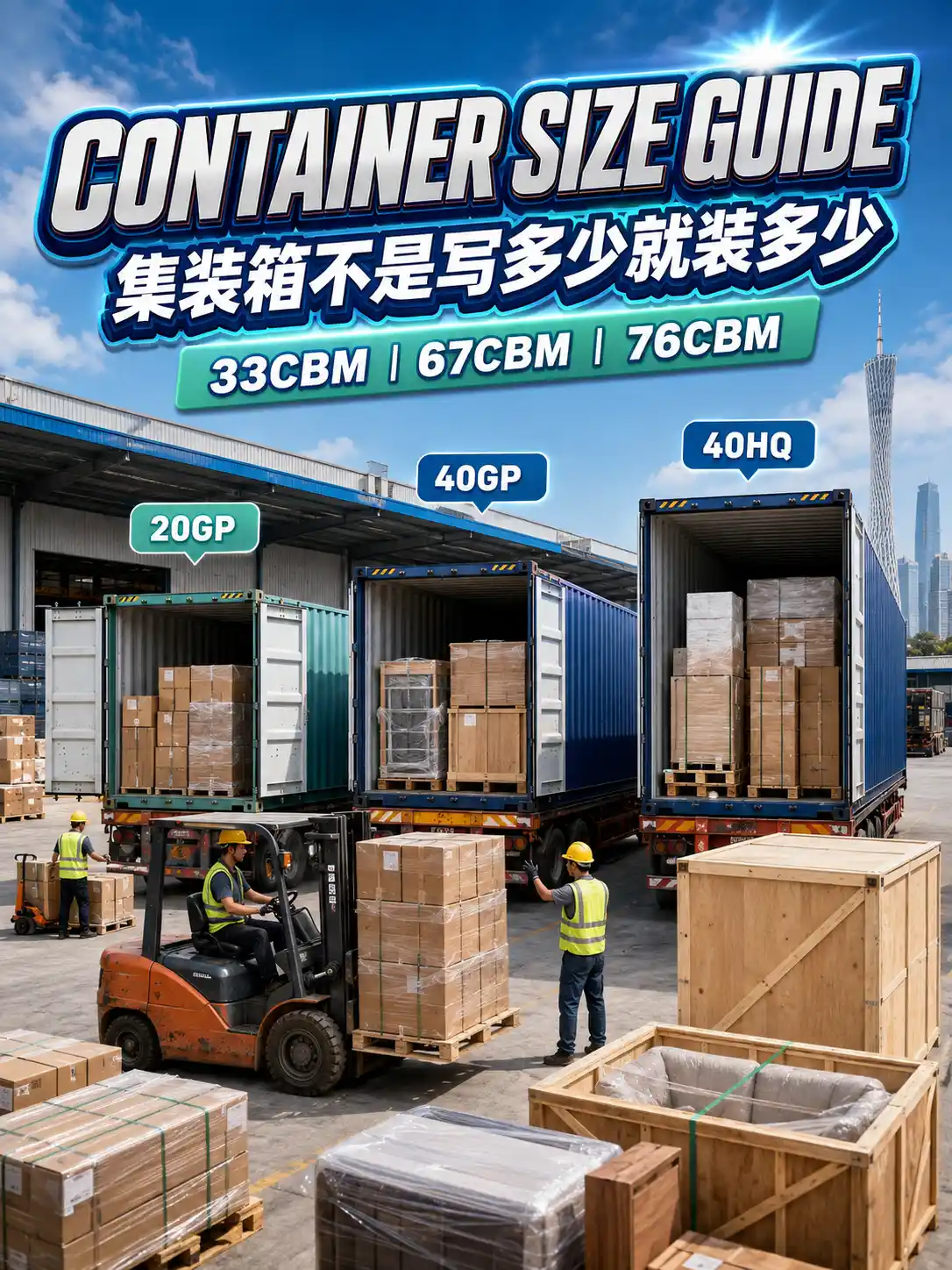
20GP / 40GP / 40HQ Container Capacity Guide
Many importers think container loading is simple: if a 20GP container has about 33CBM, then it should load 33CBM of cargo. If a 40HQ container has about 76CBM, then it should load 76CBM of cargo. Actually, this is not how real container loading works.
集装箱不是写多少立方,就真的能装满多少立方。实际装柜还要看包装、托盘、是否能堆叠、是否怕压、货物形状、装柜顺序和安全空间。
This guide explains the basic capacity of 20GP, 40GP, and 40HQ containers, and more importantly, why actual loading capacity is often lower than the theoretical container volume.
Basic Container Capacity: 20GP, 40GP and 40HQ
The following figures are commonly used as general reference. Actual loading capacity may be different depending on cargo type and packing method.
20GP Container
About 33CBM
Suitable for heavy goods, smaller volume cargo, machinery parts, hardware, tiles, tools, and compact commercial goods.
40GP Container
About 67CBM
Suitable for larger shipments, cartons, furniture parts, home goods, and mixed commercial cargo.
40HQ Container
About 76CBM
Higher than 40GP, suitable for bulky but lighter cargo, furniture, household goods, and large-volume shipments.
| Container Type | Common Reference Capacity | Best For | Important Notice |
|---|---|---|---|
| 20GP | About 33CBM | Heavy cargo, compact goods, machinery parts, hardware | Weight limit may become important before volume is full |
| 40GP | About 67CBM | General commercial cargo, cartons, mixed goods | Actual loading depends heavily on carton size and stacking |
| 40HQ | About 76CBM | Bulky cargo, furniture, household products, large-volume goods | Higher space, but still cannot always be filled completely |
Container capacity is only a reference number. It does not mean the container can always load that exact CBM. 实际装柜不是数学题,而是空间利用、货物安全和装卸操作的综合安排。
Why Actual Loading Capacity Is Lower Than Container Capacity
In real shipping, a container cannot always be loaded to 100% of its theoretical volume. The reason is simple: cargo has shape, weight, packaging, risk, and loading direction.
For example, 60CBM of soft clothes packed in strong cartons may be easier to load than 60CBM of fragile lamps, furniture, glass products, or irregular-shaped items.
很多客户只看总立方,但是仓库装柜时看到的是一件一件货。每件货的尺寸、重量、包装和能不能堆叠,都会影响最后能装多少。
1. Packaging Size Affects Container Loading
Carton size has a direct impact on container space usage. If the carton size does not match the container space well, empty gaps may appear inside the container.
For example, if cartons are too tall, too wide, or not uniform, they may not stack neatly. Even if the total CBM looks suitable on paper, the real loading result may be lower.
包装尺寸越规整,越容易装柜;包装尺寸越杂乱,越容易产生空隙。空隙一多,集装箱实际装载率就会下降。
2. Pallets Take Extra Space
Palletized cargo is easier for forklift handling and warehouse operation, but pallets also take space inside the container.
If cargo must be loaded on pallets, the actual usable space may be reduced. Pallets add height, create gaps, and may limit stacking flexibility.
This is why pallet cargo often cannot use the full container volume as efficiently as loose cartons.
托盘货更安全、更方便叉车操作,但是托盘本身也占空间。特别是出口到欧洲、英国、美国等市场,如果客户要求托盘包装,实际装柜立方通常会比散箱低。
3. Stackable or Non-Stackable Cargo Makes a Big Difference
One of the most important questions in container loading is: can the cargo be stacked?
| Cargo Type | Can Stack? | Loading Result |
|---|---|---|
| Strong cartons with light goods | Usually yes | Better container space usage |
| Fragile lamps or glass products | Limited stacking | Lower loading capacity |
| Furniture with soft surface | Depends on packing | May need protection and space |
| Machinery or irregular cargo | Often difficult | May leave unused space |
If cargo is not stackable, the container may look full from the floor, but there may still be empty space above the cargo. That empty space cannot be used safely.
这就是为什么有些货看起来才装了几十立方,柜子就不能再继续装了。因为货物怕压,上面不能再放东西。
4. Fragile Cargo Needs Protection Space
Fragile cargo cannot be loaded like normal cartons. Products such as lighting, glass, ceramics, mirrors, display cabinets, and fragile furniture may need more protection during loading.
Sometimes the warehouse needs to leave space, use corner protection, avoid direct pressure, or place fragile cargo in safer positions.
Actually, a container is not only about filling space. It is also about reducing damage risk during long-distance transportation.
If fragile cargo is forced into a container just to save space, the damage risk may become much higher. 装得太满不一定是好事,安全到货才是重点。
5. Irregular Cargo Is Harder to Load
Irregular-shaped cargo may reduce container loading efficiency. This includes machinery, display racks, curved furniture, fitness equipment, large wooden frames, and mixed project cargo.
Unlike standard cartons, irregular cargo cannot always be arranged tightly. Some parts may stick out, some may need protection, and some may not fit well with other packages.
异形货最容易出现“账面立方不大,实际很难装”的情况。因为它不是方方正正的纸箱,仓库需要考虑角度、重心、固定和安全。
6. Mixed Cargo Loading Is More Complicated
If one container contains many product types, loading becomes more complicated. Heavy goods should not be placed on fragile goods. Small cartons should not be lost between large packages. Different sizes need proper loading order.
For example, a mixed container may include:
• Furniture boxes
• Lighting cartons
• Hardware parts
• Textile products
• Fragile decoration items
• E-commerce parcels
• Wooden crates
This kind of mixed loading needs experience. The goal is not only to load more, but also to load safely.
Realistic Loading Capacity: What Should Importers Expect?
The actual loading volume depends on cargo condition. For regular cartons that can be stacked, the loading rate can be higher. For pallets, furniture, fragile cargo, or irregular cargo, the actual loaded CBM may be lower.
| Cargo Situation | Actual Loading Expectation | Reason |
|---|---|---|
| Uniform cartons, stackable | Higher loading efficiency | Easy to arrange and stack |
| Palletized cargo | Lower than loose cartons | Pallets occupy space and reduce flexibility |
| Fragile cargo | Lower loading efficiency | Needs protection and cannot be pressed |
| Irregular cargo | Uncertain loading result | Shape and safety affect arrangement |
| Mixed cargo | Depends on loading plan | Different products need different positions |
So, when someone says “40HQ can load 76CBM”, it should be understood as a reference, not a promise.
更准确的说法是:40HQ理论容量大约76CBM,但实际能装多少,要看货物本身。
How to Improve Container Loading Efficiency
Better preparation can help use container space more efficiently and reduce unexpected cost.
Before confirming FCL shipment, send cargo photos, packing list, carton size, and stacking requirements to the logistics team.
装柜前,最好提供货物图片、箱规、重量、是否怕压、是否能叠放。这样更容易判断用 20GP、40GP 还是 40HQ。
Which Container Should You Choose?
Choose 20GP if:
Your cargo is heavy, compact, and not very large in volume. Examples include hardware, tiles, machinery parts, metal products, tools, and dense commercial goods.
Choose 40GP if:
Your cargo volume is larger, but you do not need the extra height of 40HQ. It is suitable for many general commercial shipments.
Choose 40HQ if:
Your cargo is bulky but not extremely heavy. Furniture, household goods, light cartons, e-commerce inventory, and large-volume products often use 40HQ.
Actually, the best container choice is not always the biggest one. If the cargo is heavy, weight limit may be reached before space is full. If the cargo is fragile, full loading may not be safe.
Common Mistakes When Estimating Container Capacity
Many customers make mistakes because they only look at the theoretical CBM.
Common mistakes include:
• Thinking 40HQ can always load 76CBM exactly
• Ignoring pallet height and pallet space
• Forgetting that fragile cargo cannot be pressed
• Not checking whether cartons can stack
• Underestimating irregular cargo space loss
• Mixing heavy and fragile goods without loading plan
• Using oversized packaging without checking container fit
其实装柜最怕的不是少算一点立方,而是货到仓库后发现根本不像纸面上那么好装。提前确认,往往比后面补救更省钱。
FAQ - Container Capacity Guide
Can a 20GP container really load 33CBM?
Not always. 33CBM is a common reference capacity, but actual loading depends on packaging, stacking, cargo shape, and weight.
Can a 40HQ container really load 76CBM?
76CBM is a theoretical reference. In real loading, pallets, fragile cargo, irregular shapes, and non-stackable goods may reduce the actual loaded volume.
Why does pallet cargo load less than loose cartons?
Because pallets take extra space, add height, and reduce flexible stacking inside the container.
Why can’t fragile goods be loaded to full capacity?
Fragile goods may need protection space and cannot be heavily stacked. Loading too tightly can increase damage risk.
How do I know whether to choose 20GP, 40GP, or 40HQ?
You need to check cargo volume, weight, carton size, stacking ability, packaging type, and product safety requirements before choosing the container.
Need Help Choosing 20GP, 40GP or 40HQ?
YDT Logistics helps customers check cargo size, weight, packaging, loading method, and container selection before shipping.
如果你不确定货物适合 20GP、40GP 还是 40HQ,可以提前提供箱规、重量、产品图片和包装方式,我们可以帮你判断实际装柜情况,避免只看理论立方造成误判。