Outer Packaging Reinforcement for International Shipping
Outer packaging reinforcement sounds like a small detail, but actually it can make a big difference when goods travel across countries. A carton may look strong when it leaves the factory, but after loading, unloading, stacking, customs inspection, warehouse transfer, sea freight, air freight, or truck delivery, the outside box may face much more pressure than people expect. So sometimes, the product is not damaged because the product is poor. It is damaged because the outer packaging was not strong enough for international shipping.
Why Outer Packaging Reinforcement Is Important
In local delivery, one carton may only move from a warehouse to a customer’s home. The journey is usually short. But international shipping is different. A shipment may pass through several warehouses, many workers, forklifts, pallets, containers, aircraft cargo areas, customs checking areas, and local delivery stations. It is very normal for a carton to be moved many times before it arrives at the final address.
Actually, the outer packaging is the first protection layer. If this layer is weak, everything inside becomes risky. Even if the product has bubble wrap or foam inside, a soft or broken outer carton can still cause trouble. Maybe the carton gets compressed under heavier cargo. Maybe the bottom opens because the tape is too weak. Maybe the edges are crushed because there is no corner protection. These things are not rare. They happen quite often in real shipping.
Good outer packaging reinforcement does not mean making every carton like a wooden crate. That is not necessary. It means checking the cargo type, weight, size, route, transport method, and risk level, then choosing a stronger outer packaging method. Sometimes a double-wall carton is enough. Sometimes extra tape and straps are enough. Sometimes palletizing is needed. And for special cargo, wooden frame or wooden crate may be the better option.
Common Problems Caused by Weak Outer Packaging
A lot of shipping damage starts from the outside. At first, it may only be a small dent on the carton. But during long-distance transport, that small dent may become a torn box, a wet carton, a collapsed corner, or an opened bottom. This is why outer packaging reinforcement should not be ignored, especially for fragile goods, furniture, electronics, machines, heavy cartons, and high-value products.
Carton Collapse
If the carton is too thin or the goods are too heavy, the box may lose shape when stacked. Once the carton collapses, the inside product may be squeezed or bent.
Bottom Opening
This is a very common problem. The carton looks fine from the top, but the bottom tape cannot hold the weight. During lifting, the goods may fall out.
Corner Damage
Corners are easy to hit during handling. For furniture, frames, glass, machines, and big cartons, corner damage is usually the first visible problem.
What Does Outer Packaging Reinforcement Include?
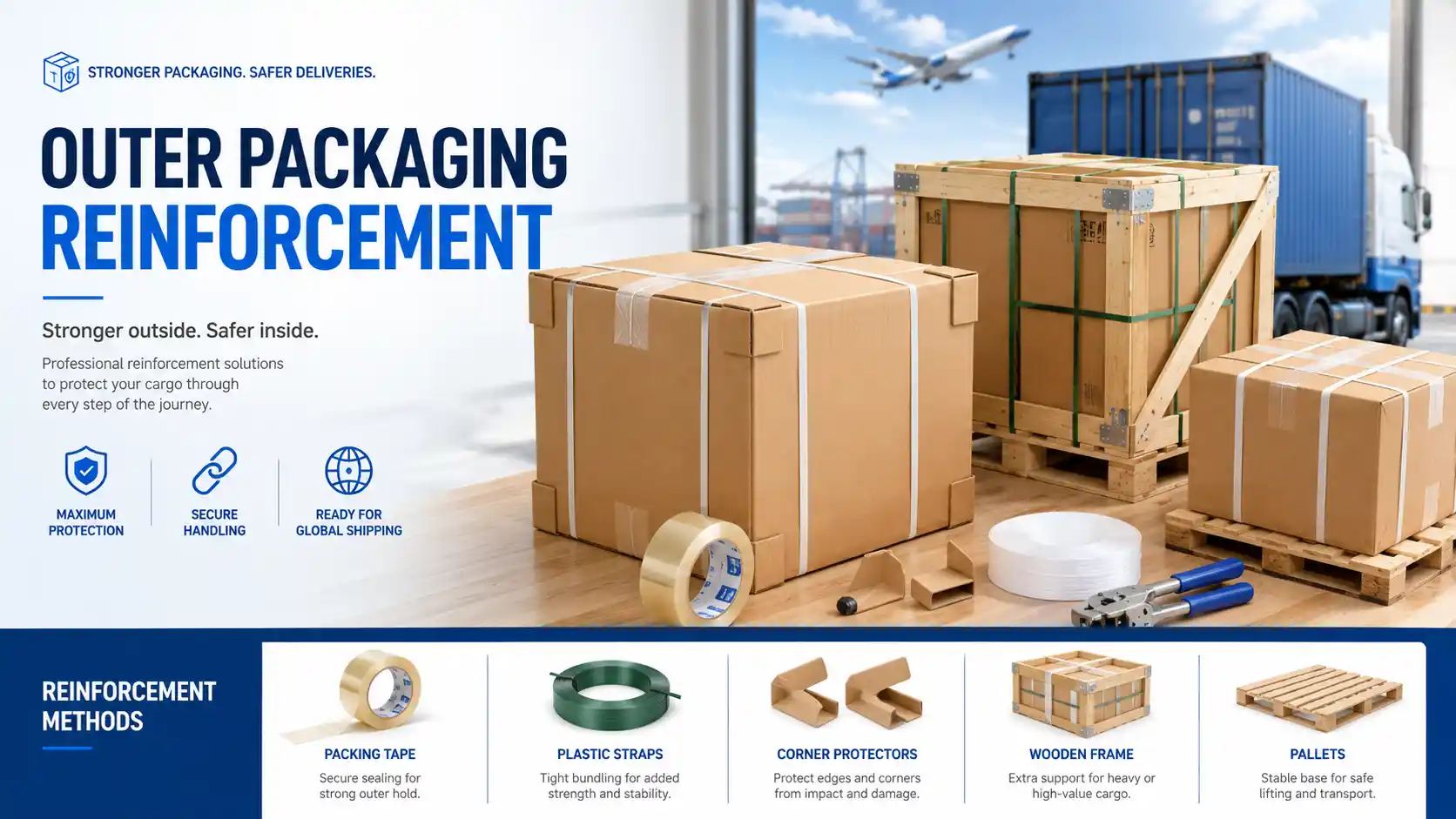
Outer packaging reinforcement means making the outside layer stronger and more stable. It can include stronger cartons, extra sealing, edge protection, corner guards, plastic wrapping, packing straps, palletizing, wooden frame, or full wooden crate. The purpose is simple: keep the cargo stable, reduce outside impact, and make the package easier to handle during transport.
Some customers may think reinforcement is only for fragile goods. Actually, not only fragile goods need it. Heavy cargo also needs it. Large-size cargo needs it. Irregular-shape cargo needs it. Goods with sharp edges need it. Products packed in soft retail boxes may also need it. If the outer box cannot protect the goods during stacking and handling, reinforcement is worth considering.
1. Stronger Carton Selection
The first step is choosing a suitable carton. For international shipping, a thin single-wall carton is often not enough, especially when the goods are heavy or the journey is long. Double-wall cartons or stronger export cartons are more suitable for many products. The carton should match the product weight and size. If the carton is too large, it leaves empty space. If it is too small, it may squeeze the product. Both situations are not ideal.
Sometimes the product comes with factory packaging, but factory packaging is not always designed for international transport. It may be okay for domestic delivery, but maybe not enough for sea freight, air freight, or truck transport across countries. So before shipping, it is better to check whether the carton can handle pressure, vibration, stacking, and repeated handling.
2. Extra Tape and Proper Sealing
Tape looks simple, but it is very important. A carton with weak sealing may open during transport. For heavy cartons, one strip of tape is usually not enough. It is better to use the H-taping method, which means sealing the center line and both side edges. This can make the carton opening stronger.
For bigger or heavier cartons, extra tape around the carton can help keep the shape. But tape should not be used to hide a weak carton. If the carton itself is too soft or already damaged, adding tape may not solve the real problem. In that case, changing to a stronger carton is more useful.
3. Packing Straps
Packing straps are often used for heavy cartons, large boxes, or goods that need extra fixing. Straps can reduce the chance of the carton opening and make it easier to lift or move. But straps should be tight enough, not too loose. Loose straps may slip off during transport.
Also, straps should not cut into the carton. If the carton is soft, the strap may press into the box and damage the outer layer. In this case, adding edge protectors under the strap may be helpful. This small detail can protect the carton and make the package more stable.
4. Corner and Edge Protection
Corners and edges are the parts most likely to be hit. For furniture, mirrors, picture frames, cabinets, marble tops, glass panels, machines, and large cartons, corner protectors are very useful. They help reduce impact and prevent the carton from being crushed at the edges.
Sometimes, the product itself is fine, but one corner is broken or deformed. This can make the whole item hard to sell or use. Maybe it sounds like a small issue, but in real business, corner damage can create complaints, returns, and extra costs. So adding corner protection is often a smart choice, especially for goods with clear edges.
5. Plastic Wrapping and Moisture Protection
Plastic wrapping is not only for making the package look clean. It can also help reduce dust, light moisture, and small scratches on the outside carton. For sea freight, warehouse storage, or rainy season shipping, moisture protection becomes more important.
Of course, plastic wrapping cannot replace waterproof packaging. If the goods are afraid of moisture, like paper products, books, fabric, leather goods, wood products, or some electronics, stronger moisture protection may be needed. Sometimes waterproof bags, desiccants, pallet wrapping, or moisture-proof film are useful. It depends on the product and the shipping route.
6. Palletizing
Palletizing is very helpful for heavy cargo, multiple cartons, or goods that need forklift handling. When goods are placed on a pallet and wrapped properly, they are easier to move and less likely to be thrown or dragged one by one. This can reduce handling damage, especially in warehouses and container loading.
But palletizing also increases volume, so the shipping cost may change. For small and light parcels, palletizing may not be necessary. For heavy, fragile, or many-carton shipments, it may be a good choice. Actually, the decision should be based on safety and cost together, not only one side.
7. Wooden Frame or Wooden Crate
For some goods, carton reinforcement is still not enough. Large machines, fragile furniture, glass, ceramic slabs, stone products, expensive equipment, and irregular cargo may need wooden frame or wooden crate packaging. Wooden packaging gives stronger outside protection and makes the cargo easier to handle.
But wooden packaging also has extra cost and may increase volume weight. Also, some countries have requirements for wooden packaging treatment or markings. So before using wooden packaging, it is better to check the destination country’s rules and the shipping channel requirements. In many cases, the forwarder can help suggest whether wooden packing is needed or not.
How to Check If Your Outer Packaging Is Strong Enough
Before sending goods overseas, you can do a simple packaging check. It does not need to be complicated. Just look at the carton from a practical point of view. Ask yourself: Can this box handle being lifted many times? Can it handle stacking? Can the bottom hold the weight? Are the corners protected? Is there any empty space inside? Is the carton already soft, wet, or damaged?
Check the Carton Strength
Press the carton gently. If it feels too soft, too thin, or easy to deform, it may not be suitable for international shipping. A stronger carton may be needed.
Check the Bottom Sealing
The bottom is very important. If the goods are heavy, use stronger tape, H-taping, and maybe straps. A weak bottom can cause the whole shipment to fail.
Check the Corners
If the product has sharp edges, fragile corners, or a large flat surface, corner and edge protection should be considered. This is very useful for furniture and large items.
Check the Package Shape
The package should be stable and easy to stack. Irregular shapes are more likely to be damaged or cause damage to other cargo. Sometimes extra carton boards or wooden frame can make the shape safer.
Check Moisture Risk
If the goods are shipped by sea or stored in a humid place, moisture protection should be checked. A dry carton at the beginning does not always stay dry during the whole journey.
Different Goods Need Different Reinforcement
Not every product needs the same packaging level. This is very important. If you use too little packaging, the risk becomes high. If you use too much packaging, the cost and volume may increase for no reason. A practical packaging plan should match the goods.
For clothes, shoes, bags, and general daily goods, strong cartons and proper sealing are usually enough. For electronics, foam protection plus stronger carton may be needed. For glass, ceramics, lamps, and decorations, inner cushioning and outer reinforcement should work together. For furniture and large goods, corner protection, carton boards, straps, or wooden frame may be more suitable. For machines and heavy goods, palletizing or wooden crate is often safer.
Outer Packaging and Shipping Cost
Some customers worry that reinforcement will increase the shipping cost. Actually, sometimes it does. Extra carton, foam board, wooden frame, pallet, or wrapping may increase size and weight. But we also need to compare it with the risk of damage. If the product is cheap and not fragile, simple reinforcement may be enough. If the product is expensive, fragile, or hard to replace, stronger packaging may save more money in the end.
It is kind of interesting: many people want to save a little packaging cost before shipping, but after damage happens, the loss may be much bigger. There may be product loss, customer complaint, return cost, replacement cost, time delay, and even bad reviews. So packaging cost should not be viewed as waste. In many cases, it is part of safe shipping.
What Information Should You Provide Before Reinforcement?
If you want a forwarder or warehouse to help check packaging, it is better to provide clear product information. Product photos are very useful. Carton size, weight, quantity, product material, product value, destination country, and shipping method are also important. If the goods are fragile, easy to scratch, afraid of moisture, or cannot be stacked, this should be mentioned in advance.
With these details, the warehouse can suggest a more suitable packaging method. Maybe only extra tape is needed. Maybe carton replacement is better. Maybe palletizing is recommended. Maybe wooden crate is necessary. Without product details, it is easy to give a wrong suggestion. So before shipping, sharing clear information can make the whole process much smoother.
Simple Q&A About Outer Packaging Reinforcement
Not every shipment needs heavy reinforcement. But if the carton is weak, the goods are fragile, heavy, large, expensive, or going through long-distance transport, reinforcement is worth checking.
Sometimes yes, but not always. Factory packaging may be designed for storage or domestic delivery. International shipping usually has more handling steps, so the packaging standard may need to be higher.
It may increase cost if it adds weight or volume. But for fragile or high-value goods, reinforcement can reduce damage risk and may save more money later.
Wooden packaging is usually considered for heavy machines, fragile furniture, glass, stone, ceramic slabs, expensive equipment, or irregular cargo. It depends on the cargo and destination rules.
Final Thoughts
Outer packaging reinforcement is not only about making the box look stronger. It is about helping the goods survive a real international shipping journey. From warehouse handling to customs checking, from container loading to final delivery, the outer package is always the first layer that takes pressure and impact.
Actually, many shipping problems can be reduced before the goods even leave the warehouse. Stronger cartons, better sealing, straps, corner protectors, moisture protection, pallets, or wooden packing can all help in different situations. The best choice depends on the goods, route, budget, and risk level.
So before shipping goods overseas, especially fragile items, furniture, electronics, machines, glass products, ceramic items, or heavy cartons, it is better to spend a little time checking the outer packaging. Maybe it feels like one extra step, but this step can make the whole shipment safer, cleaner, and less stressful.
Need Help Checking Your Packaging Before Shipping?
If you are shipping goods from China to overseas countries, you can prepare product photos, carton size, weight, quantity, and destination address. We can help check whether the outer packaging is strong enough, and suggest suitable reinforcement methods based on the real cargo situation. Sometimes, one small packaging improvement can avoid a lot of trouble later.