Visual Warnings for International Shipping Packages
Visual warnings are those clear labels, marks, stickers, and signs placed on the outside of a package. They may look simple, but actually they tell warehouse workers, drivers, customs staff, and delivery teams how the cargo should be handled. In international shipping, one package may pass through many places before reaching the customer. So a clear warning label can reduce confusion, reduce wrong handling, and sometimes prevent damage before it happens.
Why Visual Warnings Matter in Shipping
When goods are shipped across countries, they do not just move from point A to point B directly. They may go from a supplier to a warehouse, then to an export warehouse, then to customs, then to a port or airport, then to another warehouse, then to local delivery. During this whole trip, different people may handle the same carton. Most of them do not know what is inside. They only see the outside package.
This is why visual warnings are important. A carton with no label is just a carton. A carton with clear signs like “Fragile”, “This Side Up”, “Keep Dry”, or “Do Not Stack” gives people a quick message. Maybe not every worker will read a long note, but most people can understand a simple symbol or a large warning word. It is very easy to ignore, but this small thing can help a lot in real logistics.
Of course, we should also be honest. Warning labels are not magic. They cannot replace good packaging. If the product is fragile but has no bubble wrap, no foam, no strong carton, and only one “Fragile” sticker, that is not enough. Visual warnings are like a reminder. The real protection still comes from proper inner cushioning and strong outer packaging.
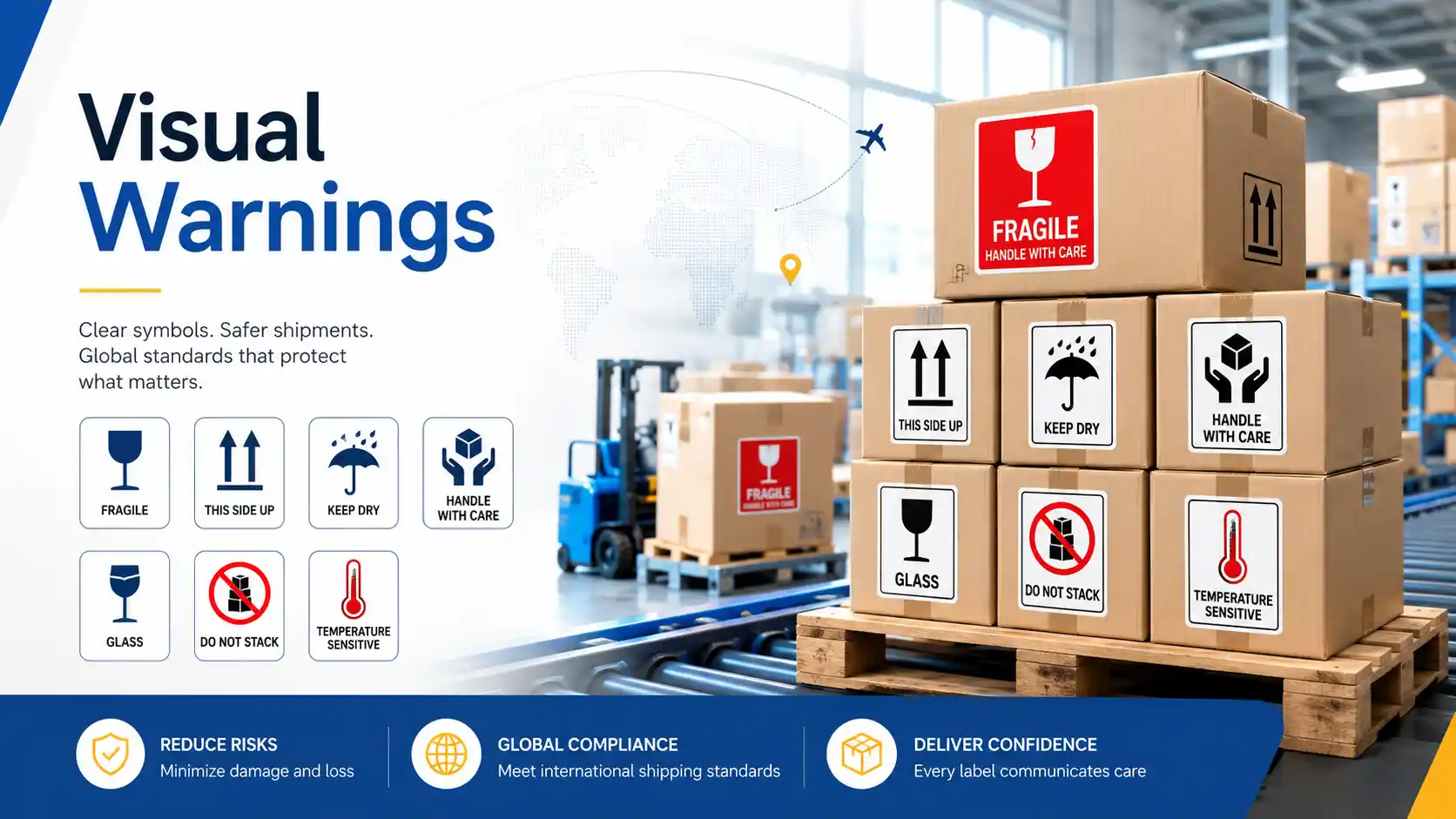
Common Visual Warning Labels
Different goods need different warning signs. Some labels are for fragile protection, some are for direction, some are for moisture, and some are for safety. Actually, a good label should be easy to see, easy to understand, and placed in the right position. If the label is too small, covered by tape, or placed on the wrong side, it may not help much.
Fragile Label
Used for glass, ceramics, lamps, mirrors, screens, decorations, and other easy-to-break items. It reminds handlers to be more careful, but it must work together with good cushioning.
This Side Up
Used when the package must stay in one direction. This is common for liquids, machines, equipment, lamps, and goods that may be damaged if placed upside down.
Keep Dry
Used for paper goods, books, fabric, leather items, electronics, wooden goods, and anything that may be affected by moisture or rain.
Fragile Warning: Useful, But Not Enough
The “Fragile” label is probably the most common warning label in logistics. Many people think once they put a fragile sticker on the carton, the product should be safe. Actually, this is a little risky thinking. The label can remind workers, but it cannot stop impact, pressure, or vibration by itself.
For fragile items, the real protection should start inside the box. Each item should be wrapped separately. Empty space should be filled. The product should not touch the carton wall directly. The outer carton should be strong enough, and for some goods, corner protection or wooden packing may be needed. The fragile label is only one part of the whole packaging plan.
It is hard to imagine, but sometimes a carton with a fragile label may still be stacked with other cartons in a warehouse. Why? Because the worker may be handling many packages quickly, or the label may not be visible from the side they are facing. So if the goods are really easy to break, do not depend on the warning label only.
Direction Labels: This Side Up
“This Side Up” is used when the package should stay upright. This is common for liquid products, some machines, electronic equipment, display items, lamps, and goods with internal parts that cannot be tilted too much. If the carton is placed upside down, the product may leak, bend, shift, or get damaged.
But again, the direction label should be clear. The arrow should be large and easy to see. It is better to place the arrow labels on more than one side of the carton, not only on the top. During transport, the top may not always be visible. If the label is on two or four sides, workers can understand the direction more quickly.
Actually, this is a common packaging mistake. Some sellers only put one small arrow sticker near the shipping label. After the carton is wrapped with plastic film or covered by other labels, the warning becomes hard to see. In that case, the label is there, but it does not really work.
Keep Dry Label and Moisture Risk
“Keep Dry” is very important for goods that are afraid of water or humidity. This includes books, paper packaging, fabric products, leather goods, wooden products, electronics, gift boxes, and some chemical or powder products. In sea freight, moisture is especially something to think about, because the journey is longer and the container may face temperature changes.
But a keep dry label does not make the carton waterproof. If the shipment may face rain, wet warehouse floor, humid weather, or long sea freight time, then plastic wrapping, waterproof bag, moisture-proof film, or desiccants may be needed. The label tells people to avoid water, but the packaging should still protect the goods if small moisture risk happens.
Do Not Stack Label
“Do Not Stack” is used when the goods cannot handle pressure from above. This may include fragile machines, lamps, glass products, display equipment, soft cartons, furniture with weak structure, or products that may deform under weight.
This label is useful, but it should be used carefully. In real shipping, especially sea freight or warehouse storage, cargo is often stacked to save space. If a package truly cannot be stacked, the outer packaging should be designed to show that clearly. Sometimes a pallet, wooden frame, cone sign, or stronger crate is needed. A small “Do Not Stack” sticker alone may not stop stacking in a busy warehouse.
So when goods cannot be stacked at all, it is better to tell the forwarder in advance. The shipping method, loading plan, and packaging method may need to be adjusted. Otherwise, the label may be noticed too late.
Heavy Cargo Warning
Heavy cargo should be marked clearly. If a carton is much heavier than it looks, workers may lift it incorrectly and drop it by accident. A “Heavy” label or weight mark can help people prepare the right handling method, like using two people, a trolley, pallet jack, or forklift.
Sometimes small cartons are surprisingly heavy, especially metal parts, machine accessories, tools, hardware, and dense materials. This is the kind of package that can easily cause handling mistakes. Marking the weight clearly is not only good for the cargo, but also safer for the workers.
Where Should Warning Labels Be Placed?
Label placement is just as important as the label itself. A warning label should be placed on a clean, flat, and visible surface. It should not be hidden under tape, covered by plastic wrap, blocked by shipping documents, or placed near a corner where it can be scratched off.
For important warnings, it is better to use more than one label. For example, if the carton needs to stay upright, put arrow labels on at least two sides. If the goods are fragile, use fragile labels on different sides, not only one side. If the package needs to keep dry, place the label where it can be seen during loading and storage.
Use Large and Clear Labels
The warning should be easy to read from a short distance. Small labels may be missed quickly, especially in a busy warehouse.
Place Labels on More Than One Side
One label may not be enough. During transport, the visible side of the carton changes, so important warning labels should appear on multiple sides.
Do Not Cover Labels With Tape or Film
If plastic wrapping is needed, make sure the warning signs are still readable. A covered label is almost the same as no label.
Match the Label With the Real Cargo
Do not put random labels everywhere. Use the correct warning for the product, so handlers can understand the real risk quickly.
Tell the Forwarder About Special Handling
If the goods cannot be stacked, cannot be tilted, or must avoid moisture, tell the logistics team before shipping. Labels help, but communication is also important.
Visual Warnings and Customs Inspection
Visual warnings may also help during customs or warehouse inspection. If the package has clear labels, staff can understand the basic handling requirement faster. For example, fragile labels can remind them to open or move the carton more carefully. Keep dry labels can remind warehouse staff not to place the goods in a wet area.
However, warning labels should not be used to hide product information. Product name, shipping label, carton mark, and required documents should still be clear and correct. If the goods are sensitive, regulated, or need special declaration, the shipper should provide accurate details in advance. Visual warnings are for handling. They are not a replacement for correct customs information.
Common Mistakes With Visual Warnings
Actually, many warning label mistakes are easy to avoid. The most common one is using labels too late or too casually. Some people only put a small fragile sticker on the carton after packing, but they do not improve the inside protection. This gives a false sense of safety.
Another mistake is using too many labels without meaning. If one carton has “Fragile”, “Do Not Stack”, “This Side Up”, “Heavy”, “Keep Dry”, and many other labels everywhere, but the goods are just normal clothes, workers may stop taking the labels seriously. Warning labels should be honest and useful.
A third mistake is poor label visibility. Labels may be printed too small, placed on dirty cartons, covered by tape, or hidden under plastic film. In that case, the package technically has a label, but in real handling, nobody can see it clearly.
What Information Should You Prepare Before Shipping?
If your cargo needs special handling, prepare the product photos, carton size, weight, quantity, product material, and shipping destination. Also mention if the goods are fragile, easy to scratch, afraid of moisture, cannot be stacked, cannot be upside down, or need forklift handling.
With this information, the warehouse or freight forwarder can help choose suitable warning labels and packaging methods. Maybe the goods only need fragile labels and better cushioning. Maybe they need direction arrows, plastic wrapping, corner protection, or palletizing. Maybe special cases need wooden frame or wooden crate. The more clear the cargo information is, the easier it is to reduce problems later.
Simple Q&A About Visual Warnings
No. Fragile labels are helpful, but they do not guarantee safe delivery. The goods still need proper inner cushioning, strong outer packaging, and good sealing.
For important warnings, multiple sides are better. During transport, workers may not see the same side every time, so one small label may be missed.
You can, but it should be reasonable. If the goods are not fragile or special, using too many warning labels may create confusion and does not really help.
Use “This Side Up” arrows, and place them on at least two sides of the carton. Also make sure the inside packaging can reduce movement if the carton is tilted.
Final Thoughts
Visual warnings are a small but useful part of international shipping packaging. They help people understand how to handle the cargo quickly, especially when the goods pass through different warehouses, trucks, ports, airports, and delivery teams. Simple signs like “Fragile”, “Keep Dry”, “This Side Up”, “Do Not Stack”, and “Heavy” can reduce many handling mistakes.
But visual warnings should work together with real protection. If the carton is weak, the inside is empty, or the product is not fixed properly, no sticker can fully protect it. The best result usually comes from clear labels, good cushioning, strong outer packaging, and proper communication with the logistics team.
Before shipping goods overseas, especially fragile items, electronics, furniture, glass, ceramic products, liquids, machines, or high-value cargo, take a little time to check the warning labels. It is a small step, but maybe this small step can make the whole delivery much safer and smoother.
Need Help With Packaging Labels and Shipping Warnings?
If you are shipping goods from China to overseas countries, you can prepare product photos, size, weight, quantity, and destination address. We can help check what visual warnings may be needed, and also suggest suitable packaging reinforcement based on the real cargo situation. Sometimes, one clear label and one small packaging improvement can avoid a lot of trouble later.