Shipping Process Control: Why Every Step Needs to Be Checked Properly
Shipping process control sounds a little serious, but actually it is just one simple idea: do not let the goods move blindly. From the moment cargo enters the warehouse until it arrives at the customer’s door, every small step should be checked, recorded, and followed up. Maybe this sounds basic, but in real international shipping, many problems happen exactly because one small step was ignored.
In international logistics, people often ask about price, delivery time, and shipping method first. This is normal. Everyone wants to know how much it costs and how many days it takes. But actually, another thing is also very important, maybe even more important in some cases. That is process control.
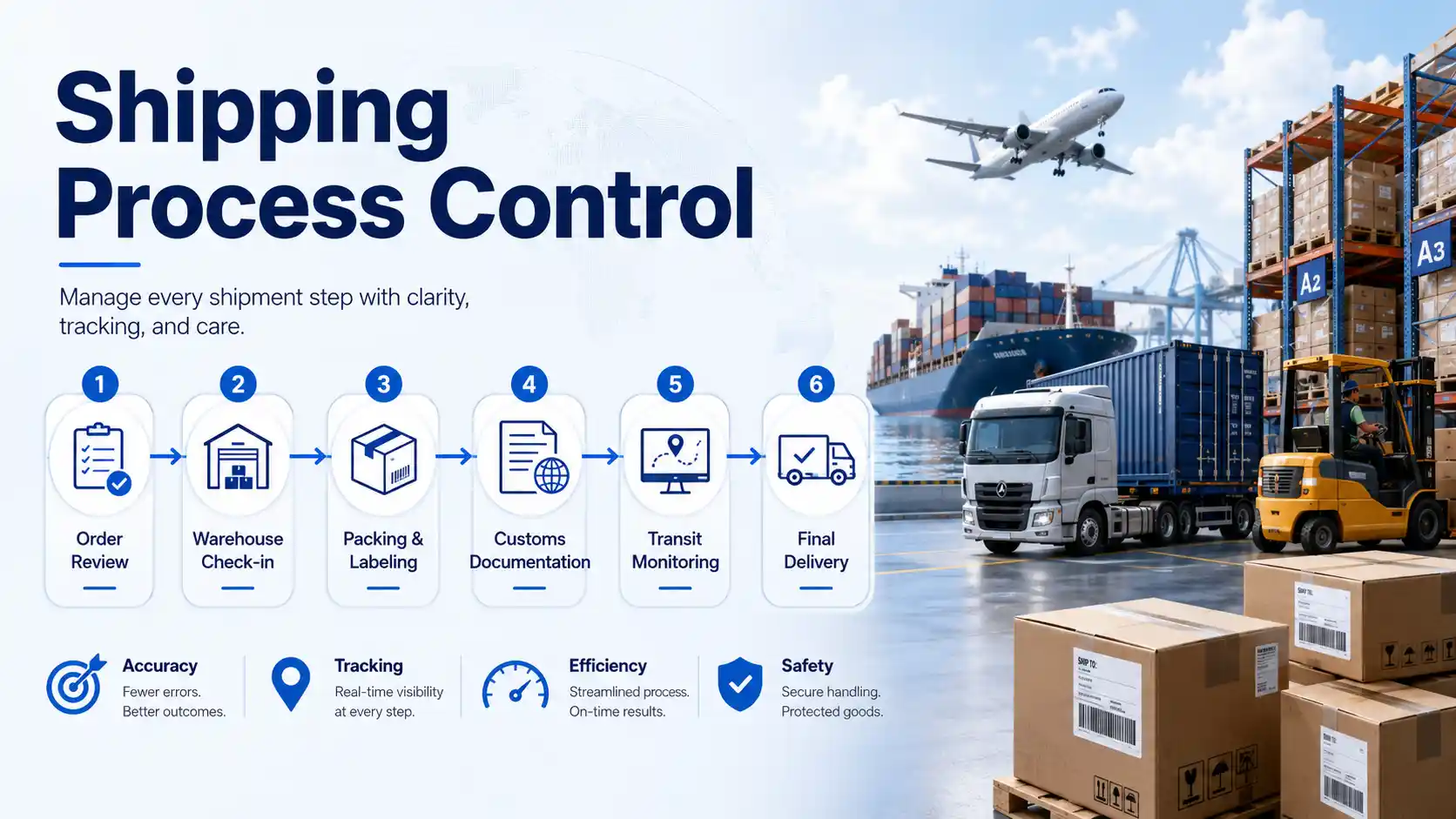
Shipping is not only “send the goods out”. A shipment may pass through supplier pickup, warehouse receiving, checking, measuring, repacking, loading, customs declaration, export, sea freight or air freight, destination customs clearance, local delivery, and final signing. Every step looks simple when we say it in one sentence, but when real cargo is moving, small mistakes can happen very easily.
For example, a carton may arrive without a label. The product name may be unclear. The weight may be different from what the supplier said. A fragile item may not have enough protection. A battery product may be mixed with normal cargo. A customer address may miss the postal code. Maybe these things look small, but once the shipment is already on the way, fixing them becomes much harder.
1. Process Control Starts Before the Cargo Arrives
Many people think shipping control starts when the goods enter the warehouse. Actually, it starts earlier. Before cargo arrives, the forwarder or warehouse should already know what kind of goods are coming, how many cartons there are, the estimated size and weight, whether there are sensitive goods, and where the goods will be shipped.
If the cargo information is clear from the beginning, the warehouse can prepare better. For example, fragile items may need extra space for inspection and reinforcement. Large furniture may need forklift or wooden frame. Liquids, powders, batteries, magnetic items, branded goods, food, cosmetics, and chemical products may need special confirmation before choosing the shipping route.
This step is not about making the process complicated. Actually, it makes the process easier. When the team knows the cargo details early, they can avoid wrong channel, wrong packing method, wrong documents, or sudden delay. In logistics, the earlier a problem is found, the cheaper it is to solve.
2. Warehouse Receiving Must Be Clear
Warehouse receiving is one of the most important parts of shipping process control. It is also where mistakes happen quite often. Sometimes suppliers send goods in several batches. Sometimes carton marks are missing. Sometimes two customers’ goods look almost the same. It is not hard to imagine how easily goods can be mixed if there is no proper control.
A good receiving process should include checking the sender information, customer code, carton quantity, outer packaging condition, and product description if available. Photos are also very helpful. They do not need to be beautiful photos, but they should be clear enough to show the carton condition, labels, and quantity.
If there is damage, shortage, wet carton, broken packaging, or unclear label, it should be reported quickly. Do not wait until the goods are ready to ship. By that time, maybe the supplier is hard to contact, or the customer already expects the shipment to leave. Actually, early reporting is one of the simplest ways to reduce disputes.
3. Measuring and Weighing Should Not Be Casual
In international shipping, size and weight directly affect the cost. Sea freight often cares about cubic meters. Air freight and express usually compare actual weight and volume weight. If the measurement is not accurate, the quote may be wrong, and the final charge may be different from what the customer expected.
This is why measuring and weighing should be part of process control, not just a quick action. The warehouse should measure length, width, height, and gross weight after receiving or after repacking. If the cargo is palletized, the pallet size should also be measured. If there are irregular items, the biggest outside dimensions are usually used.
Sometimes customers feel strange when the volume becomes bigger after reinforcement or palletizing. But actually, this is very common. Better packaging may increase the size, especially for fragile goods, furniture, machines, glass, or items with wooden frame. So it is better to explain this before shipping, not after the bill comes out.
4. Packaging Control Reduces Hidden Risk
Packaging is not only about making the cargo look nice. It is a protection step. In international shipping, cargo may be moved many times. It may be stacked, loaded, unloaded, inspected, and delivered by different teams. A weak carton may survive in the supplier warehouse, but it may not survive a long international route.
Process control means the warehouse should check whether the packaging matches the shipping route. For example, sea freight may take longer and face humidity. Air freight is faster, but cargo still needs to handle sorting and transfers. Trucking may have road vibration. Door-to-door delivery may include several loading and unloading steps.
If the goods are fragile, extra cushioning, corner protection, wooden frame, or palletizing may be needed. If the goods are heavy, strong cartons and straps may be better. If the goods are liquid, sealing and upright marks are important. If the goods are expensive, clear photos and careful packing are useful. There is no one packaging method for all cargo. The right way depends on the product.
5. Sensitive Goods Need Early Confirmation
Sensitive goods are a very common topic in international shipping. Battery, liquid, powder, magnetic items, food, cosmetics, branded products, medicines, chemicals, and some special materials may need different handling. Some can be shipped by sea. Some may not be suitable for air freight. Some need extra documents. Some routes may accept them, and some routes may not.
The problem is not only whether these goods can be shipped. The bigger problem is when people find out too late. If sensitive goods are mixed with normal goods and already loaded, then the shipment may need to be opened again. This can delay the whole batch. In special cases, customs inspection may also become more complicated.
So, process control should include sensitive goods checking before loading. The customer should provide product photos, product name, material, use, brand, and sometimes MSDS or battery information if needed. Maybe this sounds a little troublesome, but it is much better than facing a delay after the cargo has already moved.
6. Loading Control Is Also Very Important
Loading is not just putting cartons into a container or truck. Actually, loading can affect damage rate, space use, unloading speed, and delivery order. Heavy goods should usually stay at the bottom. Light or fragile goods should not be pressed. Liquids should not be placed in a risky position. Odd-size goods should be planned carefully.
For LCL shipping, this is even more important because goods from different customers may be loaded together. A strong metal part from one customer should not damage another customer’s cartons. Food should not be mixed near cargo with strong smell. Fragile goods should not be placed under heavy pallets. These are basic rules, but they need real attention.
Good loading control also includes taking photos before and after loading. When the customer can see how the cargo was loaded, they feel more confident. If there is any issue later, photos can also help check the situation. In logistics, proof is very useful. Clear records are better than only verbal explanation.
7. Customs Documents Should Match the Real Cargo
Customs clearance is one of the parts where process control becomes very important. Product name, quantity, value, material, use, and consignee information should be reasonable and consistent. If the description is too vague, customs may ask questions. If the documents do not match the real cargo, the shipment may face delay or inspection.
Many problems happen because the product name is written too casually. For example, writing “parts” or “goods” is usually not clear enough. Customs needs to understand what the item is. A better description should be simple but specific, like plastic storage box, LED light, cotton T-shirt, wooden chair, phone case, or ceramic cup.
Actually, good document control is not about making things difficult. It is about making the shipment easier to pass through the process. When the information is clear, the chance of unnecessary questions becomes lower. Of course, different countries have different requirements, so the forwarder should check route rules before shipping.
8. Tracking Updates Should Be Honest and Useful
Customers always care about where the goods are. This is very normal. But tracking updates should not be just simple words like “on the way” every time. A useful update should tell the customer the real stage, such as warehouse received, waiting for loading, departed from China, arrived at port, customs clearance, local delivery, or signed.
Sometimes there will be delay. Maybe vessel schedule changes, flight space is tight, customs inspection happens, weather affects transport, or local delivery is slower than usual. These things are not always controlled by the forwarder. But the forwarder should still follow up and explain clearly.
Actually, many customers can accept delay if they know the reason and can see someone is handling it. What customers dislike most is no update, unclear answer, or changing explanation. Shipping process control is also communication control. Clear communication can reduce anxiety and misunderstanding.
Shipping Process Control Checklist
- Confirm cargo information before goods arrive at the warehouse.
- Check carton quantity, labels, packaging condition, and customer code when receiving.
- Measure size and weight carefully after receiving or repacking.
- Check whether packaging is suitable for the shipping route.
- Separate fragile goods, sensitive goods, heavy cargo, and special items.
- Prepare clear documents that match the real cargo information.
- Take photos during receiving, packing, loading, and dispatch.
- Update shipment status honestly and follow up if there is delay.
9. Good Process Control Saves Time Later
Some people feel process control takes more time. Actually, it often saves time later. If goods are checked early, there are fewer surprises. If labels are clear, goods are easier to find. If packing is strong, damage risk is lower. If documents are correct, customs clearance is smoother. If updates are clear, customers ask fewer repeated questions.
In logistics, a messy beginning usually creates a messy ending. Maybe one missing label only takes one minute to fix at the warehouse. But if nobody fixes it, the same missing label may cause hours of checking later. This is why experienced warehouse teams and freight forwarders care about small details.
Shipping process control is not about making the work look professional on paper. It is about reducing real problems. Fewer missing goods, fewer damaged cartons, fewer wrong addresses, fewer customs issues, fewer complaints. That is the real value.
10. Final Thought
International shipping has many moving parts. No one can control everything perfectly. There may still be weather problems, port congestion, customs inspection, flight delay, truck delay, or destination delivery issues. But a good process control system can make the shipment much more stable.
For customers, choosing a freight forwarder is not only choosing a price. It is also choosing how your cargo will be handled. A low price may look attractive at first, but if the process is messy, the final result may not be good. Sometimes the safer choice is a team that checks goods carefully, explains clearly, and follows each step until delivery.
Actually, shipping process control is simple to understand: know the cargo, check the details, record the steps, solve problems early, and keep the customer updated. It may not sound fancy, but this is exactly what makes international shipping more reliable.