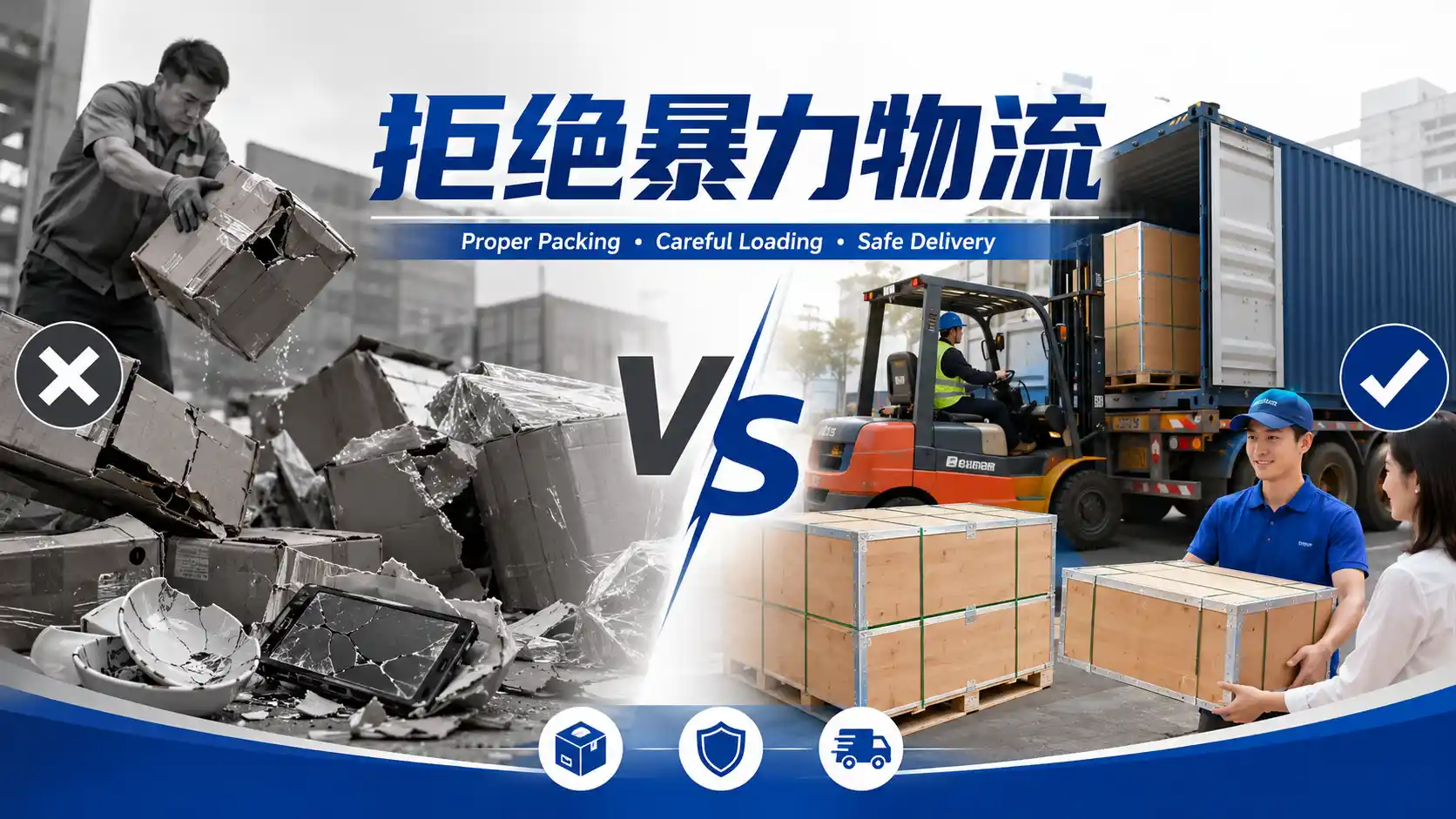
Reject Rough Handling Logistics!
In international shipping, cargo damage is not always caused by bad luck. Actually, many problems come from rough handling, weak packaging, careless loading, unclear labels, and too many unnecessary transfers. A carton does not break by itself. A wooden crate does not crack for no reason. A fragile item does not arrive damaged just because the journey is long. Very often, the real issue is that nobody treated the cargo carefully enough during the logistics process.
Why “Rough Handling” Is a Real Problem in International Logistics
Many customers search for “cargo damage during shipping,” “fragile goods shipping from China,” “how to prevent damaged goods in freight,” “safe international shipping,” “door-to-door cargo protection,” and “freight forwarder with packaging service.” These searches are common because cargo damage is one of the most annoying problems in international logistics. The goods may be valuable, customized, urgent, or hard to replace. Once they arrive broken, everybody becomes stressed.
Actually, international shipping is a long chain. Goods may move from supplier to China warehouse, then to export port or airport, then to vessel, airplane, truck, rail, customs warehouse, local distribution center, and final delivery address. During this journey, cargo may be loaded, unloaded, stacked, moved by forklift, sorted by warehouse staff, inspected by customs, and delivered by local drivers. Every step has a small risk.
Rough handling makes these risks bigger. Maybe the carton is thrown instead of placed. Maybe heavy goods are stacked on fragile cartons. Maybe furniture is dragged on the floor. Maybe glass items are loaded without enough protection. Maybe goods are transferred too many times. These things sound simple, but they are exactly where damage starts.
Careful Receiving
Cargo should be checked when it arrives at the warehouse, including carton condition, quantity, weight, size, and visible damage.
Better Packaging
Fragile goods, furniture, glass, lighting, and electronics need stronger protection before sea freight, air freight, or truck freight.
Smart Loading
Heavy cargo should not crush light cartons. Fragile items should not be placed under pressure or mixed carelessly.
Clear Tracking
End-to-end monitoring helps customers know where the cargo is and what stage may need attention.
Good Packaging Is Not Optional
Some customers think packaging is only an extra cost. But honestly, packaging is part of the shipping service. It is not decoration. It protects the cargo from squeezing, vibration, moisture, scratches, impact, and normal warehouse handling. If the packaging is weak, even a good shipping route cannot fully save the goods.
Many suppliers in China pack goods only for domestic delivery. This is a very common thing. The carton may be enough for short-distance trucking inside China, but not enough for international sea freight, air freight, rail freight, or long-distance truck freight. International transport is longer, heavier, and more complicated. A carton may be moved many times before it reaches the final address.
For fragile goods shipping, proper packaging may include bubble wrap, foam, corner protection, double-wall cartons, wooden frames, wooden crates, pallets, moisture-proof film, and clear fragile labels. For furniture shipping, edge protection and anti-scratch packing are very important. For electronics, inner cushioning and stable carton size matter a lot. Actually, one weak corner can destroy the whole customer experience.
Small reminder: “Fragile” stickers are useful, but they are not magic. A sticker cannot replace strong packaging. If the goods are valuable or easy to break, packing must be strong enough before shipping.
Rough Handling Often Starts from Poor Cargo Planning
It is easy to blame the last delivery driver when goods arrive damaged. Sometimes that is fair. But actually, damage may start much earlier. Maybe the supplier used weak cartons. Maybe the warehouse did not separate fragile goods from heavy goods. Maybe the route had too many transfers. Maybe the pallet was not wrapped tightly. Maybe the cargo was packed with empty space inside, so the products kept shaking during transport.
This is why cargo planning matters. Before shipping, the freight forwarder should know what the goods are, whether they are fragile, heavy, bulky, high-value, sensitive, or easy to scratch. Product photos, carton size, gross weight, quantity, and destination address are not just for quotation. They also help decide the packing method, loading method, route, and delivery arrangement.
For example, shipping glassware from China to Malaysia is not the same as shipping clothes. Furniture from Foshan to Europe is not the same as small accessories by air freight. A machine part going to the United States needs different protection than soft bedding going to Singapore. Different cargo needs different handling. This sounds obvious, but in real logistics, it is often ignored.
Practical Example
A customer ships lighting products from Guangzhou to Germany. The supplier uses normal cartons because the goods only travel from factory to warehouse inside China. If the same cartons go through international truck freight, customs inspection, warehouse sorting, and final delivery without reinforcement, damage risk becomes much higher. A better plan is to check the cartons at the warehouse, add foam and corner protection, reinforce the outer packaging, then arrange a safer route with fewer unnecessary transfers.
Warehouse Handling Should Be Careful, Not Violent
The warehouse is one of the most important places in cargo protection. Goods arrive from different suppliers, and this is where cartons can be checked, measured, weighed, sorted, repacked, consolidated, palletized, or reinforced. If the warehouse handles goods roughly, problems can happen before international transport even begins.
Careful warehouse handling means goods are not thrown, dragged, squeezed, or stacked randomly. Fragile cartons should be separated. Heavy cartons should be placed at the bottom. Light and soft goods should not be crushed. Furniture should not be pushed against sharp corners. If the carton is already damaged when it arrives, the customer should be informed early instead of discovering the problem after delivery.
Actually, this is where a reliable China freight forwarder can make a big difference. A good warehouse is not only a place to store boxes. It is the first checkpoint for cargo safety. If receiving, checking, packaging, and consolidation are done carefully, the shipment already has a much better start.
Route Selection Also Affects Cargo Damage
Many people only compare shipping price and transit time. But route selection also affects cargo safety. A cheaper route may have more transfers, more warehouses, more unloading, and more handling. Sometimes this is okay for normal goods. But for fragile items, furniture, electronics, glass, ceramics, lighting, machines, or high-value goods, too many transfers can increase damage risk.
For international logistics from China, customers may choose sea freight, air freight, road freight, rail freight, express courier, or DDP door-to-door shipping. Each method has different handling conditions. Sea freight is cost-effective for large cargo, but packaging must handle long transit and stacking. Air freight is faster, but chargeable weight and airport handling matter. Truck freight and rail freight can be useful for Europe, but route stability and loading method should be checked.
Actually, “safe shipping” is not always the most expensive route. It is the route that matches the cargo. If the goods are fragile, minimize transfers when possible. If the goods are bulky, check loading and palletizing. If the goods are urgent, choose a route with clear tracking. If the goods are valuable, consider insurance. This is practical risk control, not complicated theory.
What Customers Can Do Before Shipping
Customers also play an important role in preventing damage. The forwarder can help, but cargo information must be clear. If the customer only says “normal goods,” but the cargo is actually glass, cosmetics, electrical products, branded goods, or furniture, the shipping plan may be wrong from the beginning.
- Send product photos before quoting and shipping.
- Tell the forwarder if the goods are fragile, heavy, bulky, high-value, or easy to scratch.
- Provide carton quantity, gross weight, carton dimensions, and total volume.
- Ask whether carton reinforcement, wooden frame, palletizing, or moisture protection is needed.
- Confirm whether the goods need sea freight, air freight, truck freight, rail freight, express, or DDP door-to-door shipping.
- Check the destination address, postcode, delivery method, and whether unloading support is needed.
- Consider cargo insurance for valuable or hard-to-replace goods.
These details may look small, but they help avoid many problems. Actually, careful shipping starts before the goods leave the supplier.
A Safer Cargo Handling Process
Rejecting rough handling is not just a slogan. It needs a clear process from warehouse receiving to final delivery.
Reject Rough Handling, But Be Realistic Too
International shipping can never promise zero risk. This is the honest truth. Weather, customs inspection, port congestion, warehouse transfers, road conditions, flight changes, and force majeure events may still happen. Even with careful handling, goods can face unexpected problems.
But there is a big difference between normal logistics risk and careless rough handling. We cannot control everything, but we can control packaging quality, warehouse attitude, loading method, route choice, tracking, communication, and delivery arrangement. These are the parts that make a shipment more professional.
Maybe one carton is just a carton for someone else. But for the customer, it may be a paid order, a project item, a family moving item, a product sample, or stock needed for business. This is why cargo should be handled with respect. It is not only about boxes. It is about trust.
FAQ: Cargo Damage and Rough Handling in International Shipping
How can I reduce cargo damage during international shipping?
Use proper packaging, send clear product photos, choose a suitable route, reduce unnecessary transfers, and check whether palletizing or wooden packing is needed.
Are fragile labels enough to protect goods?
No. Fragile labels help remind handlers, but strong packaging is still the real protection.
Should furniture be packed differently for international shipping?
Yes. Furniture often needs corner protection, anti-scratch wrapping, stronger outer packing, and sometimes wooden frame or pallet support.
Does DDP door-to-door shipping reduce damage risk?
It can make the process easier to manage, but packaging and handling still matter. Door-to-door does not replace proper cargo protection.
Final Thought: Safe Logistics Starts with Respect for the Cargo
Reject rough handling logistics. This sentence sounds simple, but it means a lot. It means do not throw cartons. Do not crush fragile goods. Do not ignore weak packaging. Do not hide damage. Do not choose a route only because it is cheap. Do not treat customer cargo like something nobody cares about.
Actually, good international logistics is not only about price and speed. It is also about protection, communication, responsibility, and details. If the goods arrive safely, the customer feels calm. If the goods arrive damaged, even a cheap freight rate becomes meaningless.
Whether you are shipping from China to Malaysia, Singapore, Thailand, Vietnam, Europe, the United States, the United Kingdom, the UAE, or other destinations, cargo safety should always be part of the plan. Send clear details, choose proper packaging, use a reliable warehouse, and select a suitable shipping route. That is how we reduce damage, avoid trouble, and make international shipping feel much safer.
Need Safer International Shipping from China?
You can send your cargo name, product photos, carton quantity, weight, dimensions, supplier address, destination country, delivery postcode, and packaging requirements. We can help check whether your cargo needs reinforcement, wooden packing, palletizing, route adjustment, cargo insurance, or DDP door-to-door delivery support.
Contact YDT Logistics