How Typhoons Affect International Sea Freight
Typhoons can affect international sea freight in many ways. Actually, it is not only about one ship sailing slower on the sea. A strong typhoon may cause port closure, vessel schedule delay, container loading suspension, terminal congestion, trucking delay, customs clearance delay, and even last-mile delivery problems after the cargo arrives. For importers, exporters, e-commerce sellers, and freight buyers, understanding typhoon impact on ocean freight can help avoid many surprises.
Why Typhoons Matter in Ocean Freight
International sea shipping depends on ports, vessels, containers, cranes, truck drivers, customs systems, warehouses, and local delivery networks. When a typhoon comes, this whole chain can slow down. Maybe the vessel cannot berth. Maybe the terminal stops container handling. Maybe the port yard becomes congested. Maybe trucks cannot enter the port area because of heavy rain or road control. It sounds like one weather event, but the impact can spread across many steps.
This is why people often search for “typhoon impact on sea freight,” “ocean freight delay,” “port closure due to typhoon,” “vessel schedule delay,” “container shipping delay,” “ETD ETA update,” “cargo tracking during bad weather,” and “port congestion after typhoon.” These are not just keywords. They are real problems that shippers face when the weather changes.
Actually, typhoon delay is very common in Asia shipping routes, especially around South China, East China, Japan, Korea, Taiwan, Hong Kong, Vietnam, Philippines, and some Southeast Asia routes. It may also affect transshipment hubs. Even if your cargo is not directly near the typhoon area, the vessel or container may still be affected if it passes through a delayed port.
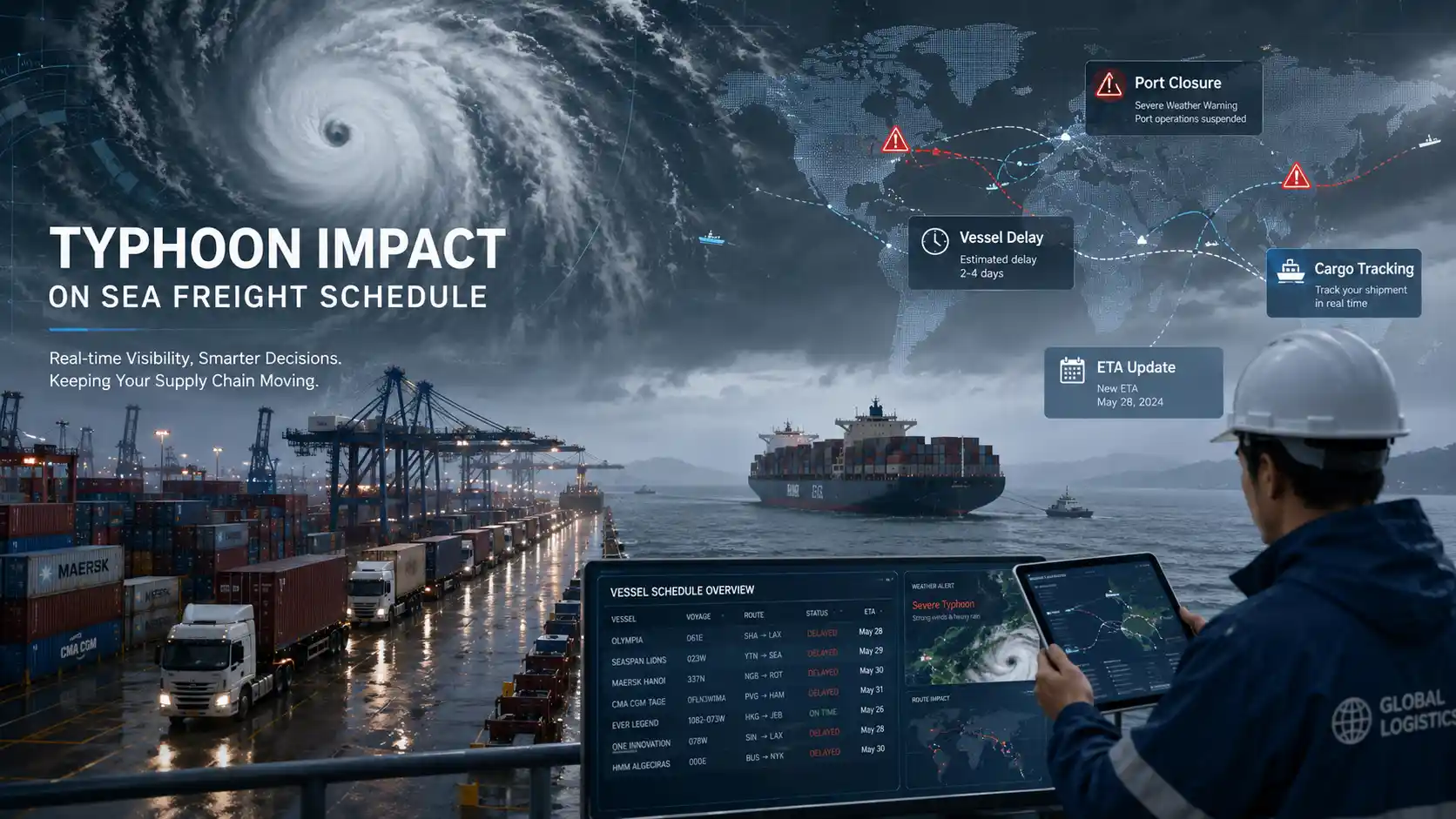
Port Closure
Terminals may stop gate-in, loading, unloading, pilotage, or crane operations when wind and waves become unsafe.
Vessel Delay
Ships may slow down, wait outside port, change rotation, skip a port call, or adjust ETD and ETA after bad weather.
Port Congestion
After reopening, many vessels and containers arrive together, so berth waiting time and yard pressure can increase.
Delivery Impact
Trucking, warehouse unloading, customs clearance, and final delivery may also be delayed, even after the storm passes.
1. Port Closure and Terminal Suspension
The most direct impact is port closure. When wind speed, heavy rain, wave height, or storm surge becomes risky, port authorities and terminal operators may suspend operations. This can include container gate-in, container gate-out, loading, unloading, pilotage, yard operation, and vessel berthing. Actually, this is normal safety control. Nobody wants cranes, ships, containers, or workers to operate under dangerous weather.
For shippers, the problem is timing. If your container has not entered the terminal before the cut-off time, it may miss the vessel. If the vessel cannot berth, loading may be delayed. If the port closes suddenly, trucks may need to wait outside or return to the warehouse. In special cases, export cargo may need to wait for the next sailing.
This is why container cut-off time, port opening status, and warehouse dispatch planning are very important during typhoon season. A shipment that looked safe yesterday may become risky today if the terminal changes the gate-in schedule.
Small reminder: when a typhoon warning is active, do not only ask “Has my vessel departed?” Also ask whether the container has entered the port, whether the terminal is operating, and whether the sailing schedule has changed.
2. Vessel Schedule Delay and ETA Changes
Typhoons can easily create vessel schedule delay. A ship may slow down to avoid rough sea conditions. It may wait outside the port until pilotage resumes. It may change rotation and call another port first. Sometimes a vessel may skip one port call and discharge cargo at another port for transshipment. Maybe this sounds unusual, but in international sea freight, it does happen.
The difficult part is that ETA may change more than once. A vessel may first be delayed one day, then three days, then wait again because the port is congested after reopening. This is why cargo tracking during bad weather should not only rely on one old schedule. ETD, ETA, vessel name, voyage number, port rotation, and transshipment status should be checked again.
Actually, many customers feel anxious because they see no update for a while. But sometimes the cargo is not lost. It is simply waiting under weather control, port congestion, or vessel schedule adjustment. Clear communication from the freight forwarder is important at this point.
Practical Example
A container is planned to ship from Shenzhen to Malaysia. Before departure, a typhoon warning affects the South China coastal area. The terminal stops some operations, the vessel delays berthing, and the container misses the original loading window. After the port reopens, many vessels wait at the same time, so the new sailing is also delayed. The final delay may not be only one day. It can become several days depending on port recovery and vessel space.
3. Port Congestion After the Typhoon Passes
Many people think everything will return to normal right after the typhoon leaves. Actually, not always. After a port reopens, delayed vessels may arrive together. Containers that were waiting outside the terminal need to enter. Trucks that could not deliver before now rush back. Warehouses also need to handle delayed cargo. This can create port congestion and container yard pressure.
When congestion builds up, vessel waiting time can increase. Container loading and unloading may become slower. Some shipments may be rolled to the next sailing. Transshipment cargo may also be delayed because the connection vessel has already left or is full. This is why typhoon impact on sea freight may continue even after the weather looks better.
For import cargo, port congestion may also affect customs clearance and local delivery. The vessel arrives late, the container is discharged late, the customs declaration starts late, and the delivery appointment also moves later. It is like a chain reaction. One delay pushes the next step.
4. Trucking and Warehouse Delays
Ocean freight is not only about ships. Trucks are also part of the shipment. Before export, trucks need to pick up goods from suppliers or warehouses and deliver containers or LCL cargo to the port. During typhoon weather, road conditions can become difficult. Heavy rain, flooding, traffic control, bridge closure, and driver safety rules may slow down inland transport.
If the cargo is still at the factory or China warehouse, it may not reach the terminal before cut-off. If the cargo has arrived at the destination port, local trucks may also delay final delivery because of road restrictions or warehouse closure. Actually, this is why door-to-door shipping can be affected even when the vessel itself is already safe.
For LCL sea freight, warehouse consolidation can also slow down. If many suppliers deliver goods late because of weather, the shipment may miss the planned container loading. This is a very common situation during typhoon season.
5. Customs Clearance and Document Timing
Typhoons do not directly change customs rules, but they can affect document timing and clearance flow. If port operations stop, containers may not be discharged on time. If the container is not available, customs inspection may be delayed. If the local warehouse is not working, documents and cargo handover may also slow down.
For DDP door-to-door shipping, customers often expect the forwarder to handle everything. That is fine, but during typhoon disruptions, customs clearance, tax handling, warehouse sorting, and last-mile delivery may all need extra time. A realistic ETA is better than a beautiful promise.
Actually, the smartest thing is to prepare documents early. Invoice, packing list, product description, HS code, customs information, and consignee details should be ready before the cargo arrives. If documents are already messy, bad weather will make the situation even harder.
Which Shipments Are More Sensitive to Typhoon Delays?
Not every shipment feels the same impact. Some cargo can wait. Some cannot. If the goods are seasonal, urgent, high-value, fragile, or connected to a project deadline, typhoon delay can be more painful. For example, e-commerce inventory, exhibition goods, factory spare parts, construction materials, event supplies, holiday products, and customer project cargo may need extra attention.
- Seasonal goods that must arrive before a selling period.
- Amazon FBA stock or e-commerce inventory with stockout pressure.
- Furniture and household goods needed for moving or opening a shop.
- Machinery parts or production materials needed by a factory.
- Fragile cargo that may face more risk during repeated handling.
- LCL cargo that depends on warehouse consolidation and container loading schedules.
- Transshipment cargo that may miss the next connection vessel.
If your shipment belongs to these types, it is better to leave buffer time. Do not plan sea freight too tight during typhoon season. Maybe the route is normally stable, but weather does not care about our schedule.
How Shippers Can Reduce the Impact
We cannot stop a typhoon. But we can reduce the trouble by planning better. Actually, many losses come from poor timing, unclear communication, weak packaging, or no backup plan. A better logistics plan can make the shipment more flexible when bad weather happens.
Should You Change from Sea Freight to Air Freight During a Typhoon?
Maybe yes, maybe no. If the goods are very urgent and still have not entered the sea freight process, air freight may be a backup option. But if the cargo is already in the port, already loaded, or already sailing, changing to air freight may not be possible. Also, during bad weather, air cargo can also face flight delay, airport congestion, and limited space.
So the better question is not “Is air freight always better during a typhoon?” The better question is: where is the cargo now, how urgent is it, how big is it, and what is the cost of delay? If the cargo is small and urgent, air freight can be useful. If the cargo is bulky, heavy, or already loaded by sea, waiting for ocean freight recovery may be more realistic.
Actually, a good freight forwarder should help compare the real options, not just say “change channel” casually. Every change has cost and timing.
FAQ: Typhoon and International Sea Freight
Can a typhoon delay ocean freight?
Yes. A typhoon can delay vessel departure, port berthing, container loading, customs clearance, and final delivery.
Will the port close during a typhoon?
Sometimes yes. If wind, waves, heavy rain, or storm surge creates safety risk, terminals may suspend operations temporarily.
Why is my cargo still delayed after the typhoon passed?
After reopening, ports may face vessel queues, yard congestion, truck delays, and missed transshipment connections.
How can I reduce typhoon shipping risk?
Send cargo earlier, prepare documents early, track ETD and ETA, leave buffer time, and keep communication open with your freight forwarder.
Final Thought: Weather Delays Are Not Always Avoidable, But They Can Be Managed
Typhoons are part of international sea freight risk, especially during typhoon season in Asia. They can affect port closure, vessel schedule, container loading, cargo tracking, customs clearance, and door-to-door delivery. Sometimes the delay is small. Sometimes it becomes a chain reaction across several ports and shipping schedules.
Actually, the goal is not to pretend weather will never affect shipping. The goal is to plan with common sense. Send goods earlier when possible. Do not push the cut-off too tight. Prepare customs documents before the vessel arrives. Check port congestion and ETA updates. If the cargo is urgent, ask for backup options early.
International sea shipping is still one of the most cost-effective ways to move cargo around the world. But during typhoon season, customers should give the shipment a little more time and a little more attention. A realistic plan is always better than a rushed plan that depends on perfect weather.
Need Help Checking Sea Freight Risk During Typhoon Season?
You can send your cargo name, product photos, carton quantity, weight, dimensions, supplier address, destination country, delivery postcode, and preferred delivery time. We can help check sea freight route, warehouse timing, port status, customs clearance, cargo tracking, and possible backup shipping options.
Contact YDT Logistics