Route Selection: Minimize Transfers; Prioritize “Direct” Routes
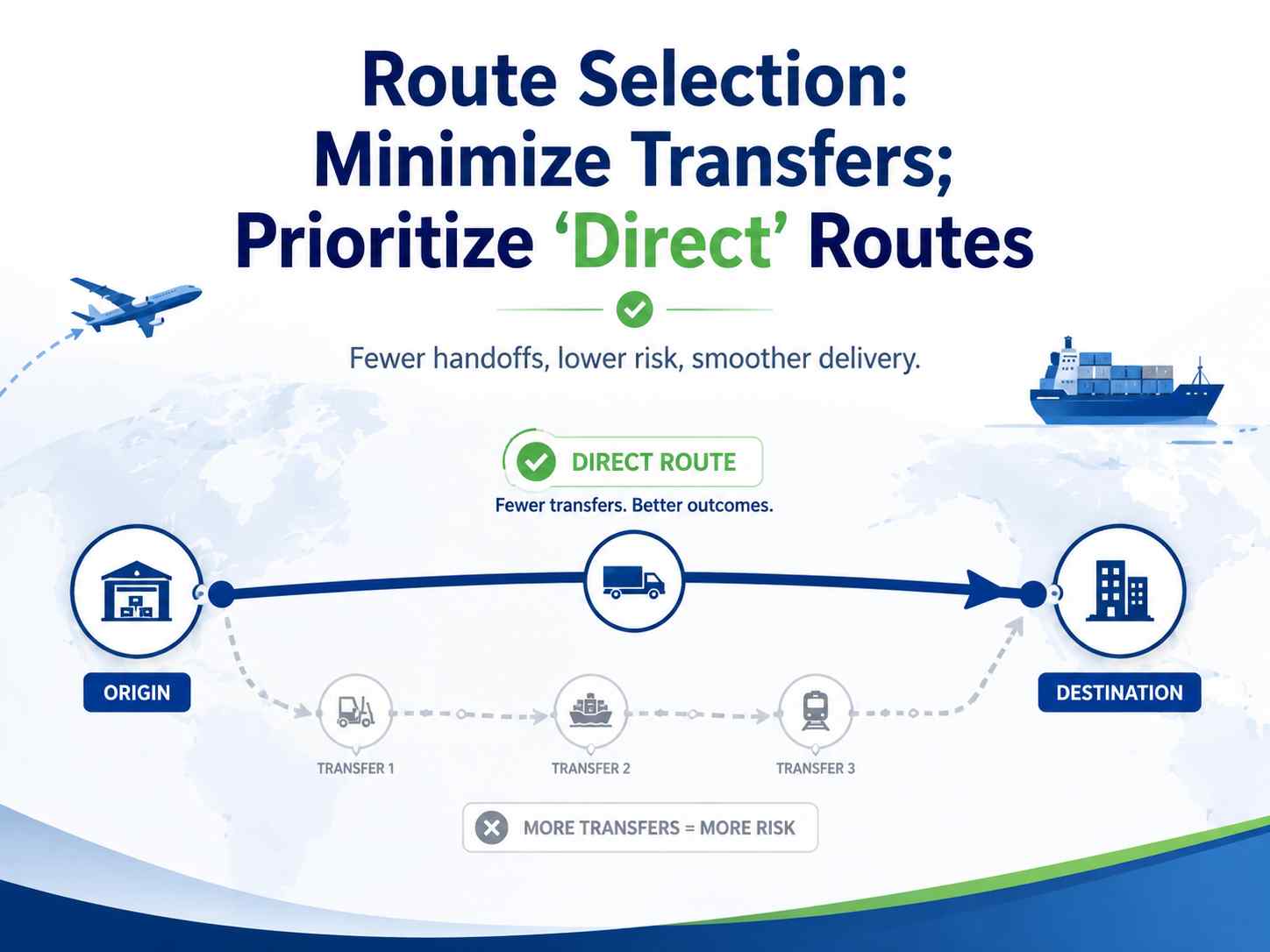
In international shipping, many people only look at price and transit time. Actually, route selection is just as important. A shipment with fewer transfers usually has lower risk, cleaner tracking, less handling damage, and more predictable delivery. Sometimes the cheapest route looks attractive at first, but after several transshipments, delays, reloading, and warehouse moves, it may not be cheap anymore.
Why Route Selection Matters More Than Many People Think
When customers ask for a shipping quote, they often ask two questions first: how much and how long. This is normal. Everybody wants a good price and fast delivery. But in real logistics, the route behind the price is very important. Maybe two shipping plans both say “25–35 days,” but one route is direct from China to the destination port, while another one needs two or three transfers in different ports or warehouses. These two are not the same thing.
Actually, every transfer is a small risk point. The goods may be unloaded, moved, sorted, reloaded, scanned, stored, or handled again. For strong industrial cargo, maybe this is not a big issue. But for fragile items, furniture, glass, electronics, personal goods, display products, lighting, or high-value cargo, too many transfers can easily increase the chance of damage or delay.
This is why “direct route” is not just a nice marketing word. It is a practical way to reduce trouble. The fewer times your cargo is touched, the fewer chances something goes wrong. It sounds simple, but in international shipping, simple is often safer.
Less Handling
Fewer transfers means fewer loading and unloading steps. That usually reduces carton damage, pallet breakage, and missing package risk.
Cleaner Tracking
Direct routes are often easier to follow. When goods move through too many points, tracking may become slow or confusing.
More Stable Timing
Every transfer may add waiting time. If one connection is missed, the whole schedule can be pushed back.
What Does “Direct Route” Really Mean?
A direct route does not always mean the goods move from your supplier to your final door without any stop. In logistics, this word can mean different things depending on the shipping method. For sea freight, it may mean a direct vessel from the loading port to the destination port, or at least no unnecessary transshipment. For air freight, it may mean a direct flight or fewer airport transfers. For land transport, it may mean one stable trucking line instead of changing trucks many times.
So when you hear “direct,” it is better to ask one more question: direct from where to where? Some routes are direct to the destination country but still need local transfer. Some are direct to a main city, then local delivery to another city. Some routes may be called direct, but actually they still pass through a transit hub. This is not always bad, but it should be clear.
A good freight forwarder should explain the route in a practical way, not only give a beautiful transit time. For example: goods collected in Guangzhou, loaded from Shenzhen or Nansha port, direct vessel to destination port, customs clearance, then local truck delivery. This kind of explanation helps the shipper understand where the risk points are.
Small reminder: the lowest price route is often not the safest route. Sometimes it is cheaper because the cargo waits longer, transfers more, or uses a less stable connection. It may still be useful for low-value goods, but not always suitable for fragile or urgent cargo.
Every Transfer Adds a Little More Risk
Transfers are not automatically bad. International shipping sometimes needs them. Maybe there is no direct vessel to a smaller destination port. Maybe the air route needs one connection. Maybe inland delivery requires a warehouse transfer. This is normal. But unnecessary transfers should be avoided when possible.
Think about a carton of ceramic lamps or glassware. It leaves the supplier, goes to a warehouse, gets loaded into a truck, unloaded at the port warehouse, loaded into a container, unloaded at transit port, loaded again, unloaded at destination port, moved to customs warehouse, then delivered by local truck. That is a lot of movement. Even if everyone is careful, the chance of carton pressure, corner damage, water exposure, or missing label becomes higher.
This is also true for furniture. Furniture may be large, awkward, and easy to scratch. Every extra move increases the chance of dent, broken corner, dirty surface, or packaging damage. Sometimes the goods are not totally broken, but they arrive with small damage that customers do not accept. That kind of problem is very common and very annoying.
So, actually, reducing transfers is not only about speed. It is about controlling the whole journey. Fewer hands, fewer warehouses, fewer forklifts, fewer connection points — the shipment becomes easier to manage.
Direct Routes Are Especially Important for Certain Goods
Not every shipment needs the most premium route. If the cargo is low-value, not fragile, not urgent, and the customer accepts longer transit time, a route with transfer may be okay. But for some goods, direct or low-transfer routes are strongly recommended.
- Fragile items such as glass, ceramics, lamps, mirrors, stone products, and display racks.
- Furniture, especially large sofas, cabinets, tables, chairs, and custom-made wooden items.
- Electronics, machines, instruments, and products with higher unit value.
- Seasonal goods that must arrive before a sales campaign, exhibition, or project deadline.
- Personal moving cargo, because many items are difficult to replace after damage.
- Branded goods or commercial stock where missing cartons may cause customer complaints.
- Large-volume shipments where one delay may affect the whole inventory plan.
For these goods, saving a small amount of freight by choosing a complicated route may not be worth it. Maybe the route is cheaper by 5% or 10%, but if one carton is damaged, one pallet is delayed, or one connection is missed, the loss can be much higher.
Practical Example
A customer ships 20 cartons of lighting products. Route A is a little cheaper but needs two transfers. Route B costs slightly more but goes through a more direct shipping line. If the goods are not urgent and packaging is very strong, Route A may be acceptable. But if the lights are fragile, customized, or needed for a project, Route B is most likely safer. This is the real point of route selection: not always choosing the cheapest, but choosing the route that matches the cargo.
How Transfers Affect Transit Time
Many people think transit time is only about the sailing days or flight hours. Actually, waiting time can be the bigger problem. A shipment may arrive at a transit port quickly, but then wait for the next vessel. If the connection is missed, the goods may sit there for several days, sometimes longer. This is why routes with many transfers can become unstable.
The same thing can happen with air freight. A flight may be fast, but if the cargo needs to transfer through another airport, waiting time, customs checks, airline space, and warehouse sorting can all affect the final delivery. Sometimes an air shipment looks fast on paper, but after all the transfers, it is not much faster than a more stable channel.
For land transport, changing trucks or warehouses can also add uncertainty. If the first truck arrives late, the next connection may already be gone. Then the goods wait. This is why a stable direct trucking line can sometimes perform better than a route that looks faster but changes too much.
How to Choose a Better Route
Choosing a better route does not mean always paying the highest price. It means matching the cargo with the right transportation plan. Actually, a good route should balance cost, time, safety, and predictability. Before shipping, you can ask a few simple questions.
- Does this route need transshipment? If yes, how many times?
- Which port, airport, or warehouse will the goods pass through?
- Is the route stable recently, or often delayed?
- Is this route suitable for fragile, valuable, or oversized cargo?
- Will the cargo be reloaded, separated, or mixed with many other shipments?
- Is there a more direct route with a slightly higher but acceptable cost?
- Does the route include customs clearance and final delivery clearly?
These questions are simple, but they can help avoid many problems. Sometimes the answer will show that the cheapest route is fine. Sometimes it will show that the cargo needs a safer plan. The key is to know the route before shipping, not after the goods are already delayed somewhere.
A Practical Route Selection Process
For international shipping, route selection should be done before cargo leaves the supplier. Once the goods are already loaded, changing the route becomes more difficult. A practical process can make things easier.
Direct Route Does Not Mean Zero Risk
It is also important to be realistic. A direct route reduces risk, but it does not remove all risk. Weather, customs inspection, port congestion, local holidays, vessel schedule changes, airline space, and force majeure events can still happen. International shipping is not like sending a local parcel across town. There are always moving parts.
But a direct or low-transfer route makes the shipment easier to control. When something happens, it is easier to know where the goods are and what step is affected. With too many transfers, finding the exact problem can be slower. Maybe the cargo is at a transit warehouse, maybe it missed the next vessel, maybe it is waiting for sorting. This kind of unclear situation is what many customers dislike the most.
So the goal is not to create a perfect route. The goal is to choose a route with fewer unnecessary risks. That is already a big improvement.
Final Thought: Fewer Transfers, Fewer Surprises
In international logistics, route selection is not just a back-office detail. It directly affects cargo safety, delivery time, damage risk, and customer experience. Maybe the customer only sees a price on the quotation, but behind that price there is a full route, including ports, warehouses, trucks, vessels, flights, customs, and delivery steps.
If your cargo is valuable, fragile, urgent, customized, or hard to replace, it is better to minimize transfers and prioritize direct routes when possible. Maybe it costs a little more, but the shipment becomes cleaner, easier to track, and more predictable. Actually, that small extra cost can be cheaper than dealing with damage, missing cartons, late delivery, or customer complaints later.
The best route is not always the cheapest route, and not always the fastest route on paper. The best route is the one that matches the cargo, controls risk, and helps the goods arrive safely. That is the real value of smart route selection.
Need Help Choosing a Safer Shipping Route?
You can send the cargo name, product photos, carton size, weight, quantity, destination country, and delivery address. We can help check whether sea freight, air freight, land transport, rail, or express is more suitable, and also help compare direct routes and transfer routes before shipment.
Contact YDT Logistics